
There are many strategic transition challenges facing the Power Generation and Distribution Market.
Traditionally, electricity has been generated, through a centralised model, in large power plants, transferred through transmission and distribution networks and delivered to end users in the residential, commercial, industrial and transport sectors. Traditional grids are based on a technical paradigm where the low- and medium-voltage parts – the distribution grids – traditionally pass on power generated elsewhere in one direction to consumers, who are passive recipients.
Centralised Generation System
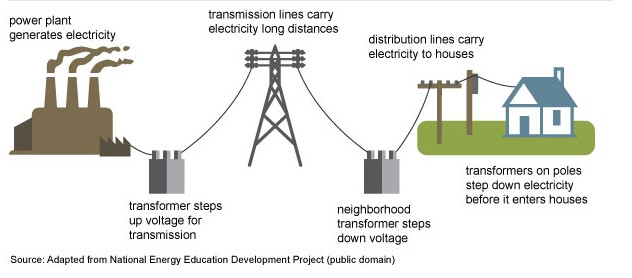
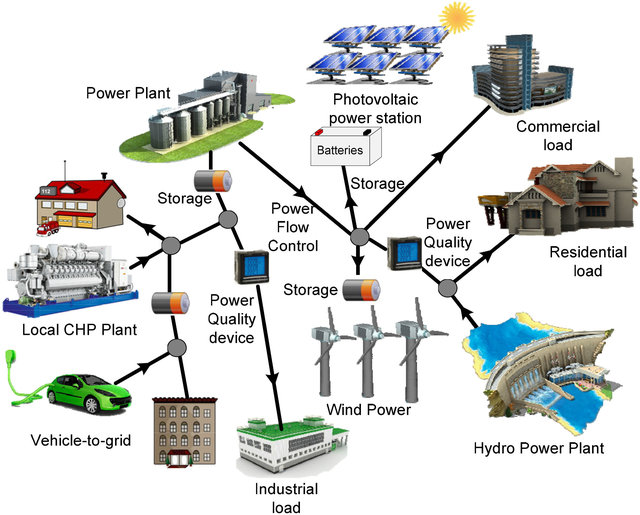
As the generation shifts from conventional power to renewable sources, it has to move away from the centralised model to a decentralised model since the renewable sources of power generation are located in different places. The new power markets are created through distributed energy systems which build on complex interconnected hardware systems and require novel solutions that support the exchange of energy and related data.
Distributed Generation System
Available via license: CC BY 3.0
Transition Challenges
In a decentralised energy system, the individual producers and consumers of energy needs to be integrated to manage the production and consumption of energy. This integration would provide not only scalability, but also, match the demand and supply, to meet increasing demands of energy. At the same time, any credible alternative to traditional model needs to be cost effective and resilient to facilitate mass adoption.
The challenge lies in the coordination of the activities of the different players in the platform into a cohesive whole. In many cases, this coordination act makes the difference between coherence and failure. There are many critical areas of transition challenges which are discussed below.
Optimal energy management
The energy grid is a critical infrastructure of society ensuring uninterrupted power supply in an efficient manner. Energy management continues to play a key role in a decentralised model of power generation, albeit moving from the grid to micro-grids. Every segment of the value chain – households, prosumers, distribution, transmission, generation and retail – needs to be connected to enable the formation of an energy-efficient and environmentally friendly energy market. A fully-functioning and intelligent energy management system is required to keep the system balanced across production, consumption, and storage. It is also required to enable innovative ways of power distribution, grid monitoring and communication as it enhances the transfer of energy and data bidirectionally.
Changing industry dynamics
Porter, 1979 stated the industry forces – suppliers, customers, competition, substitution and barriers to market entry – are key to explaining industrial dynamics. The competitive forces are driven by the power of suppliers and customers in the value chain. The entry of new players or products or services brings about a change in the industry dynamics. Digitalisation has initiated changes to the business models and has an impact on the industry dynamics. Freeman’s stakeholder view identifies actors such as environmentalists and consumers advocated as actors impacting firms and industries.
Entry of prosumer model of energy consumption and generation can influence a change in industry dynamics. Prosumer is consumer that acts as a producer. A prosumer can be an individual person as household level customer, a larger building (e.g. apartment building or shopping centre), business entity like organisation or a firm, or other kind of community. Prosumer may assume different level of activities including personalisation that can vary from producing energy for own use to sharing excess energy through the grid and becoming an active participant in the energy industry.
Decentralised energy generation
Deploying local solar plants, small wind farms, battery storage and combined heat-and- power is replacing the centralised model with smaller, nimbler, decentralised sources of energy. Digitalisation along with the reduction in the prices for renewable technologies have improved the economics of the small scale decentralised power generation. However, the uptake of decentralised energy faces a number of challenges such as new disciplines on suppliers and customers, complexity of technology with respect to grid connection and reverse-metering, contracting and managing etc.
Policy and regulations
In many markets, policy has been lagging behind the development in technologies and it has been an absolute barrier to the growth of decentralised model. Traditionally, policies were developed by energy experts talking to energy experts, but now since the market participants include industries, prosumers, businesses; their participation is vital to achieve the growth and the security of energy supply. Policy makers and energy industry need to start bringing their former customers, and new competitors, into their policy conversations.

 STRATEGIC VALUE